Lucban, Province of Quezon
08 February 2016
 We left Paranaque at 0505H and traveled down south to Lucban in the province of Quezon to visit "Kamay ni Hesus" shrine. We were five. We took the SLEX.
The road was clear and there was no traffic at that time. I was supposed to hike at Mt. Pulag up north however, due to the DENR restrictions I decided to join the team for another road trip.
We had light conversations as we enjoyed the lush green scenery along SLEX. At 0631H, we had a rendezvous at Petron gas station for breakfast.
MAJAYJAY CHURCH
At 0735H, we reached the province of Laguna and decided to visit Majayjay Church and drop by at the souvenir shops. The place is known for its quality shoes and slippers. We were lucky that the church was open at that time.

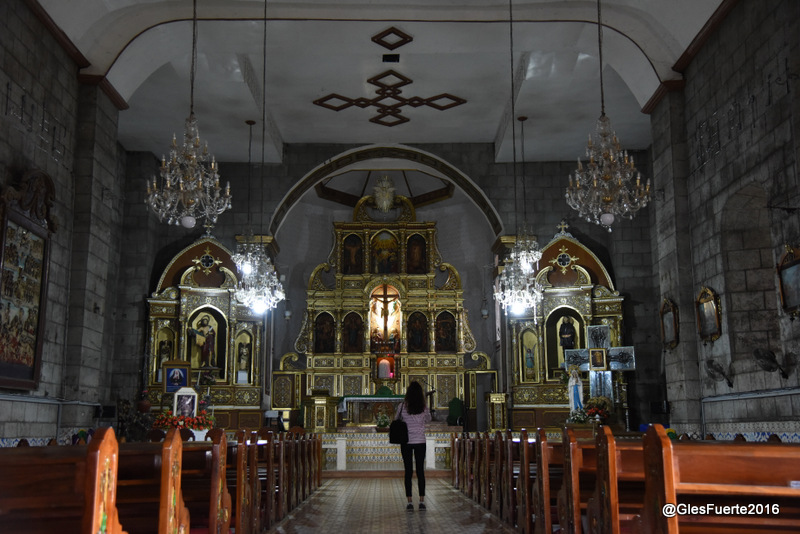


According to to Wikipedia, The San Gregorio Magno Parish Church (Filipino: Simbahan ng Parokya ni San Gregorio Magno; Spanish: Iglesia Parroquial de San Gregorio Magno), also known as Majayjay Church and St. Gregory the Great Parish Church, is one of the oldest Roman Catholic churches in the Philippines located in the municipality of Majayjay in Laguna. It is recognized by the National Museum as a National Cultural Treasure (Level 1). The current parish priest is Father Robin A. Dagala.
The Romanesque church of Majayjay is 60 metres (200 ft) long, 17 metres (56 ft) wide and 16.5 metres (54 ft) meters high. Its façade has three levels, each level scaled proportionally and topped by a triangular pediment with a circular window. The central nave consists of a huge wooden door of the main portal, choir loft windows and saint's niche. The interior contains a retablo mayor and four other minor retablos with intricate designs. The floor is tiled with azulejo and the walls have been preserved with some alterations. The five-storey square belltower with a conical roof and ballustrated windows on each polygonal level is connected to the langit-langitan, a cat-walk above the ceiling which leads to the crossing over the transept. The belfry has arched windows each with a bell trimmed with finials and a large antique bell on top. It also has a large side door on the right side of the church.
Today, the church contains antique images of santos, reliquaries and century-old liturgical objects.
The Romanesque church of Majayjay is 60 metres (200 ft) long, 17 metres (56 ft) wide and 16.5 metres (54 ft) meters high. Its façade has three levels, each level scaled proportionally and topped by a triangular pediment with a circular window. The central nave consists of a huge wooden door of the main portal, choir loft windows and saint's niche. The interior contains a retablo mayor and four other minor retablos with intricate designs. The floor is tiled with azulejo and the walls have been preserved with some alterations. The five-storey square belltower with a conical roof and ballustrated windows on each polygonal level is connected to the langit-langitan, a cat-walk above the ceiling which leads to the crossing over the transept. The belfry has arched windows each with a bell trimmed with finials and a large antique bell on top. It also has a large side door on the right side of the church.
Today, the church contains antique images of santos, reliquaries and century-old liturgical objects.
KAMAY NI HESUS SHRINE
From Majayjay, we traveled further down south towards Lucban, Quezon. Along the way, we passed-by the Lucban Church. At 0928H, we reached the shrine.

It was cold and drizzling at the area. We had planned to attend the 1000H mass however, we learned from the parish office that the parish priests were on retreat and so there was no mass on that day.


From the church, we took the 300+ steps stairway towards the ascending Christ statue atop the hill. It was wet.


We had to queue along the stairway. Standing atop the hill beside the statue, one can see the beautiful landscape of the surroundings.


We had to queue along the stairway. Standing atop the hill beside the statue, one can see the beautiful landscape of the surroundings.

Beside the hill is a park with a museum. The parish office is located beside the park and shaped like an ancient ark.


LUCBAN CHURCH
At 1140H, we left the shrine. We were back at Lucban town proper at 1155H. It was still drizzling. We parked at the plaza facing the church. I had a chance to take few photos of the centuries old structure and I was hoping to see the interior however, the church was closed at the time.


According to Wikipedia, Franciscan priests Father Juán Portocarrero de Plasencia and Father Diego de Oropesa de San José, known as the Apostles of Laguna and Tayabas, established the visita of Lucban in 1578 and started evangelizing the people of the town. It was elevated as a parish in 1595 under Father Miguel de Talavera alongside the construction of its first church made of wood, dedicated to Saint Louis of Toulouse.
The first church was ruined in 1629 and a second church was established on the present site. Construction of the second church, made of stone, masonry, and nipa, proceeded from 1630 to 1640 and the convent was finished in 1650. Church roofing was changed to tiles in 1683 under the supervision of Father Francisco Huerta.
Fire destroyed the building in 1733. That same year, Father Pascual Martinez began construction of a third building, the present one, which was completed in 1738. The rebuilt convent was completed in 1743. On April 4, 1945, the day American soldiers liberated Lucban during World War II, the church was partially damaged by a bomb. It was immediately reconstructed under the supervision of Monsignor Antonio Radovan.
In July 2014 Typhoon Glenda destroyed the roof over the altar, causing flooding inside the church.
The church follows the baroque design. It has a three-storey facade. The second level features semi-circular windows flanked by Corinthian columns and niches containing statues of saints. The church also has an octagonal, three-story belltower standing on a square base.
We decided to have a lunch at the town and we looked for a famous restaurant. We found the restaurant beside the plaza with the town marker however, it was full. Instead of waiting, we decided to try the famous "Pansit Hab-Hab" instead.


The pansit was served on a square green banana leaf. According to the locals, "Hab-Hab" means to eat without the use of spoon and fork. It was my first time to try that famous pansit of Lucab and I must admit that I liked it. It tastes insanely delicious and for P16.00, we had a complete Pansit Hab-Hab meal. We left Lucban town proper at 1217H.
TAYTAY FALLS
On our way back home, we saw a signage going to Taytay Falls. It was approximately 3 kilometers away from the main road. NRV insisted that we should see the falls. According to the locals, it is the second most famous falls in Laguna after Pagsanjan.


From the main road, we turned left towards the falls. The road leading to the falls is paved and surrounded by lush green forest. At 1250H, we reached the jump-off point. From the jump off point, we walked for another 1 kilometer to reach the falls.


At that time it started to rain. The trail going to the falls is paved and well maintained. Beside the trail is a crystal clear fresh running water from the mountain.


At 1316H, we reached the waterfalls. The water was crystal clear and very cool. There is a camp site at the area.

One thing that I noticed was the concrete barrier that was built in front of the water falls such that the water coming from the falls will be contained to form like a swimming pool. The natural flow of the water was somehow unnaturally modified. Nevertheless, it is a very nice waterfalls.
NAGCARLAN UNDERGROUND CEMETERY
From the waterfalls, we traveled north and reached Nagcarlan in Laguna at 1450H. At Nagcarlan, I was reminded of the Underground Cemetery which I visited three years ago with a friend and then we saw the signage. We didn't realize that we were just few meters away from the cemetery. We parked at a gas station located just in front of the cemetery and then we walked towards the half-opened iron gate.

The church, which is the entrance to the underground cemetery, was closed at that time and so we just took photos at the gate.


ISDAAN FLOATING RESTAURANT, CALAUAN LAGUNA
From Nagcarlan, we proceeded to Calauan to see the Isdaan Floating Restaurant. I missed to see the Isdaan Floating Restaurant in Tarlac when we visited Monasterio de Tarlac and so I was so happy to be at the place.


The place is nice. We had a sumptuous "boodle fight" late lunch.


From Calauan, we traveled back to Manila. We were back home at 2016H.
--o0o--


