Showing posts with label #baroque. Show all posts

Thursday, August 17, 2023

Breaking-in My New Travel Companion - Kronos!

Revisiting Pagudpud - Laoag City - Paoay - Vigan City - Bantay - Sta. Maria - Little Batanes
August 17 - 20

I just got a new DJI Air 3 Drone I named "Kronos" and I thought of breaking it in somewhere safe to fly Drones. It was just in time for the August long weekend and the first Drone friendly destination I had in mind was Ilocos beaches and heritage sites. 
Kronos Drone

I decided to quickly get a bus ticket and travelled right away to Pagudpud, my first destination. This is a peaceful place where the white sand beaches are and few other popular tourist destinations such as the Kapurpurawan Rock formation, Burgos Light House, Patapat Viaduct and of course, the Windmills all over the place. All of which a perfect spot to test flight Kronos.
  
August 17: Travel from Manila to PAGUDPUD
Took a bus in Sampaloc bound for Pagudpud. Travelled at night and reached Pagudpud early morning the following day.

August 18: PAGUDPUD | Beach Time
Upon my arrival at the bus terminal, contact a friend, Jerry Galat, for the usual tricycle ride from the bus terminal to my favorite accommodation few steps away from the municipal white sand beach in Saud. I checked it at Polaris Beach Resort and started to unpack my things, setup Kronos and made my first flight under the clear blue sky moving back and forth along the shores of Saud.


It was my first time to handle an Air 3 aircraft and so I decided to stay in the area for the whole day to familiarize  my self with the Drone before testing it in the tourist spots.

August 19: Travel to LAOAG | PAOAY | VIGAN | BANTAY | STA. MARIA
Early on the 19th August, I travelled to the City of Laoag, Kronos with me. Plan was to fly Kronos at some popular heritage spots and see the beauty of the place from above. 

At the Laoag City proper, I passed by and took photos of the Sinking Bell Tower before proceeding to the Cathedral to say a short thank you prayer. I was tempted to fly Kronos around the Belfry, however, given the setting of the area, I decided not to. Kronos is equipped with omni directional sensors to avoid any collision but I decided not to fly given my lack of flight experience yet.
 

From the Belltower, I proceeded to the Cathedral opposite the highway. Just like before, the Cathedral is clean and orderly. 


After saying my thank you prayer, I decided to walk towards the market to see Auntie Elie and try a dozen of her special Laoag Longaniza and sweet curly Balikutsa.


From the market, I took a tricycle going to the Jeepney terminal bound for Paoay. Travelled to Paoay and checked it at Dreamtime Inn located few steps away from the rear side of Paoay Church.

After fixing my things inside the Inn, I prepared Kronos for a flight at the church Plaza and headed immediately to the site to start my drone break-in flight. I was so excited and so happy to be able to fly Kronos and take a shot of the magnificent structure from above.


Paoay Church Master Shot

As part of the break-in activities, I also took a Master Shot video of the church and few more Quick Shots. It was a very nice experience, having to pilot a very nice, stable drone equipped with a 4K resolution camera.


From Paoay church, I decided to travel to Vigan City. Flying a drone along Calle Crisologo requires a permission from the City Police office for security. I decided not to fly Kronos along Calle Crisologo and instead took few selfie shots while walking towards the City Center.

Took a quick refreshment at MCDonalds while viewing the facade of Vigan Cathedral being repaired as a result of the strong quake.

From Vigan plaza, I decided to take a tricycle ride to Bantay Church and Belltower. These two structures were badly damaged by the earthquake. Good thing, repair was on-going at that time starting with the facade and side wall of the church. 

The Belltower still stands and with cracks. It was still off limits to the public for safety.

I decided to fly Kronos and performed "Point Of Interest" encircling the belltower and then took a shot of the Bantay church from above.


Bantay Bell Tower Master Shot

It was a hot and humid day. From Bantay, I took a van towards Sta. Maria. My plan was to take a Master Shot of Sta. Maria Church. I was so happy to see that the church situated atop a hill is so intact, no damage seen at all after the massive earthquake - standing true to its UNESCO title as Baroque Church, an earthquake-proof structure.

Using Master Shot, I was able to record a video that can be readily shared on any Social Media platform. This is a beautiful feature of modern day drone equipment.


Sta. Maria Church Master Shot

From Sta. Maria, I took a bus bound for Laoag and alighted at a junction towards Paoay. Finally checked in at Dreamtime Beach Resort, took a nice dinner and then rest with a happy heart knowing I was able to fulfil all my plans for the day.

August 20: Travel from Paoay to PAGUDPUD
Early morning on the 20th, went to the bus terminal bound for Pagudpud and travelled back to the white sand place, checked in at Polaris Beach Resort and prepared to explore Little Batanes located at Brgy. Caparispisan in Pagudpud.


We had a short climb, up a hill and the view is stunning. It has a panoramic view close to that of the rolling hills of Batanes, hence, tourists call it the Batanes of Ilocos Norte.

From the hill, we travelled below and visited the Stingray monument. This is a World War II historical market.


Travelled back to Saud beach, get some few souvenirs and travelled back to Manila. I was happy and satisfied having been able to unwind in this peaceful, orderly place.

Dios ti Agngina!

-o0o-

Sunday, January 15, 2017

The Paoay Church (San Agustin), A UNESCO World Heritage Site

Paoay, Ilocos Norte
03 November 2013

Paoay Church taken during Spanish - American War
Photo Source: http://freepages.military.rootsweb.ancestry.com/~smokymtnman/spanish/saw4.jpg
Aside from Vigan, the Paoay church, also known as San Agustin church, is another site that I cannot afford to miss whenever I travel to the Ilocos provinces. It is one of the four Baroque Churches in the Philippines inscribed by UNESCO as a World Heritage Site.

Summary/Historical Context of UNESCO, The explorer Ferdinand Magellan arrived in the Philippines in 1521. His name was Ferdinand Magellan, known for his voyage around the world. He claimed the islands of the Philippines as a Spanish colony. Missionary priests came to spread the Catholic faith. 

Many churches were built throughout the country. Four of them were inscribed as World Heritage in 1993. The churches have survived several earthquakes and wars, and are known as "Earthquake Baroque" due to their strong quake-resistant structures. 

This pyramid-like building is the Church of San Agustin in Paoay in the Northern Luzon. Construction started in 1694. It incorporates many architectural features from Latin America, which was also colonized by Spain at the time. Typical Latin American motifs such as the sun are used as decoration. 

As The Philippines are affected by earthquakes, the buildings have some unique features to cope. These 2.5 meter-thick supporting buttresses were built around the church as protection. from the impact of an earthquake. The material used to make the wall is also unique. Pieces of coral were used along with regular brick for construction. Coral is said to be twice as strong as brick. 
This church has been hit by two giant earthquakes in the last 300 years but owing to its quake-resistant structure has remained intact."Architectural techniques brought from Mexico and Spain bloomed in the Philippines, making great buildings like this church. By combining different techniques this church stood strong in the earthquake of Intensity 7.

Facade and Bell Tower of Paoay Church
According to UNESCO, this church is the most massive church of all churches in the Philippines with 24 massive buttresses measuring nearly 3-meters thick built around the church 2 meters thick walls as protection.

The materials used to build the walls and buttresses are made of coral stones cut into square blocks, bricks and adobe stones and then glued together using sugar cane and egg white.
Massive Church Facade
24 S-shape Massive Buttresses nearly 3 meters thick
According to Wikipedia, the church facade also exudes Javanese architecture reminiscent of Borobudur of Java.
Javanese Architecture
Building of the present church started in 1694, according to historians. This church has been hit by 2 giant earthquakes in the last 300 years but due to its quake resistive structure, it remained intact to date.
Third layer of the church facade bearing the old seal of Spain
Furthermore, UNESCO said that this church is the best example of a Baroque church in the Philippines.

Watch Baroque Churches of the Philippines, according to UNESCO.

Just like the developments in the City of Vigan, there are many developments at the UNESCO World Heritage site of Paoay. 

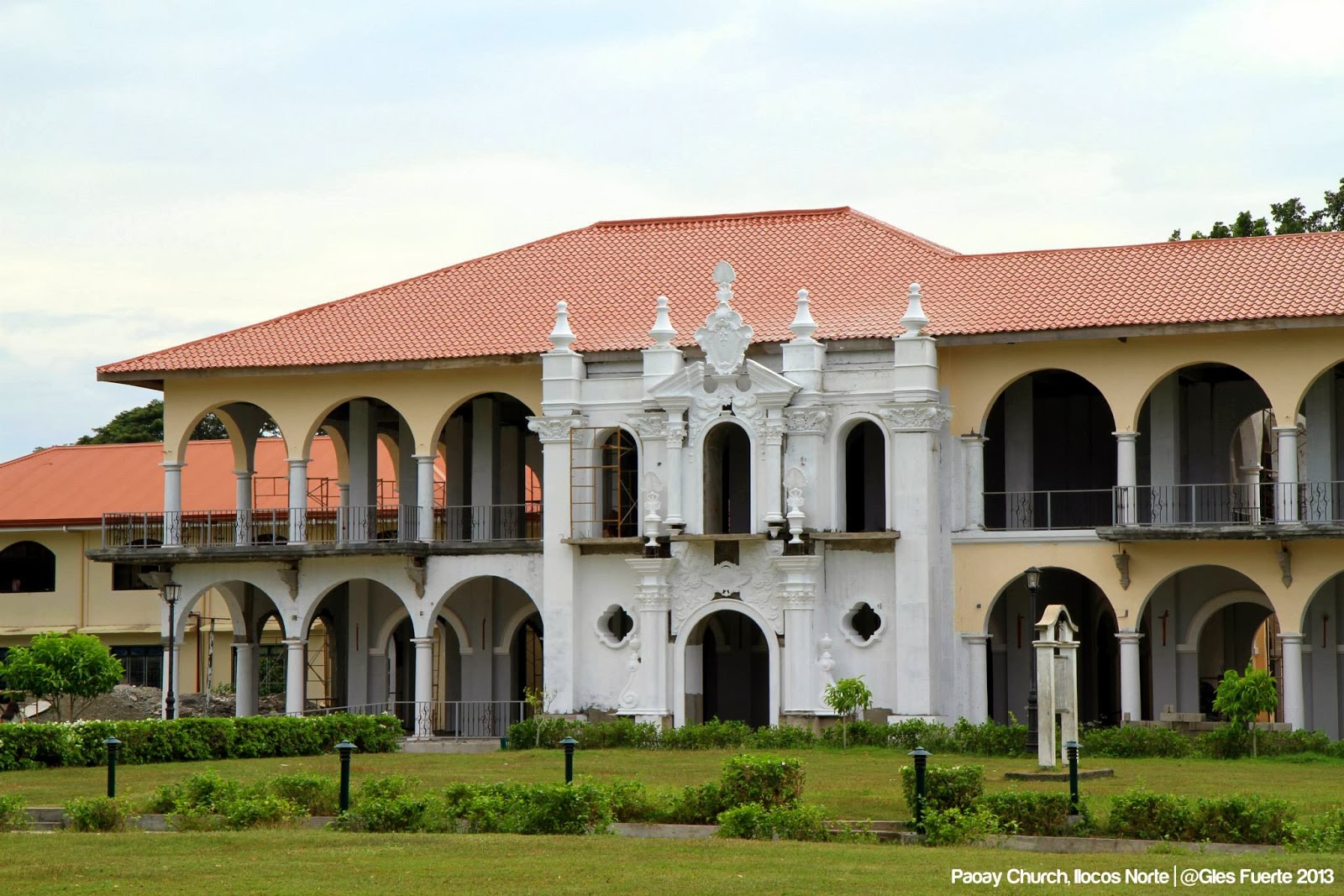
Facing the facade of the church at the right side of the Plaza, there is a new building, which was currently being constructed by the time of visit, that will house the tourism office of Paoay, Ilocos Norte.
Future Tourism Office at Paoay, Ilocos Norte
The left side of the church has been developed and turned into a beautiful garden called "Jardin de San Agustin".
Jardin de San Agustin
The parish residence is a new building constructed at least 20 meters away from the church to provide a buffer zone as required by UNESCO.

Inside the church, the altar was improved with the statue of San Agustin at the main altar and the altar table now dressed in gold-color with intricate designs.
 
More and more visitors are coming to Paoay to see the church and other tourist spots at the area.

To get a view of the church facade at night, I stayed late at the plaza and waited for the lamp posts and wall lamps to light up and even at night, the grandeur of the church can't be denied.
Paoay Church at night
Truly, Paoay Pumaypayapay (Kumakaway)!

Rediscovering Paoay
23 December 2015

I reached Paoay at 2010H from Laoag City. At that time, the church facade and side walls had been illuminated with warm light.

After fixing my things at my accommodation, I immediately moved to the plaza with my camera and tripod. Taking photos at night of old structures nicely lit is one of my favorite photo moments.
 
A lighted scroll mark at the plaza ground was lighted making it very visible at dark.
The building at the right side of the plaza (facing the church) that was under construction when I last visited the place is now a souvenir shop and a food court.

On the 23rd of December, I moved around the Paoay church and explored the old convent that used to be in ruins and currently being restored at the time. The PGIN is transforming the building ruins into another tourist site in Paoay.
By the time of my visit, half portion of the old building had already been covered with a metal roof supported by metal columns and trusses. I was so happy to learn that the old convent ruins will be resurrected soon and will no longer be just a ruin.


I left Paoay at 1700H and traveled back to Laoag City and then later traveled to my hometown in the province of Isabela.

Paoay Church Retrofitting
17 February 2012

The Paoay Church also know as San Agustin Church in Paoay Ilocos Norte is one of the only 4 ancient catholic churches in the Philippines listed in the UNESCO World Heritage list. 
Church Facade with Scaffolding
This church, according to the experts, was constructed in 1694 and made of massive coral blocks. Standing through war and earthquake for more than 300 years, the church finally require renovation. 
According to Paoay officials, the renovation will restore the designs on the massive walls of the church. For the past hundreds of years since the colonial period, for many times many churches and old buildings have been destroyed by either natural calamities and wars and for many times, the Ilocoanos also rebuilt or restored them. This is a testimony of how the Ilocanos love and value their heritage. 
I can't wait to see the church fully renovated and marvel at its grandeur.

-o0o-

Saturday, August 23, 2014

Explore Sta. Monica Church and its Bells

Panay, Capiz
August 23, 2014

One of the highlights of my trip to the City of Roxas in Capiz was to explore the Sta. Monica church, also known as Panay church and its unusual large bell still attached to its belfry. According to reports, this is the largest church bell in the entire country.

According to Wikipedia, Santa Monica Parish Church, also called Panay Church, Spanish: Iglesia Parroquial de Santa Mónica, is a historic church in Panay, near Roxas City in the province of Capiz, on Panay island in the Western Visayas region of the Philippines. It was built in 1884 on the site of an earlier church, built in 1774 by Miguel Murguia, which was gravely damaged by the typhoon of 17 January 1875. The church is built of coral blocks and is approximately 70 metres long, 25 m in width and 18 m in height; the walls are about 3 metres thick.

The church has an unusually large bell, the largest in the country. This was cast by Juan Reina in about 1884, using sacks of coin given by the people of the town; it weighs more than 10 tonnes. 

In 1997 the church was declared a National Historical Landmark by the National Historical Commission of the Philippines.

After completing my trip to Lawis, I headed back to the plaza and returned to my inn. It was just past three in the afternoon and I decided to visit the Sta. Monica Church in the town of Panay.

From the plaza, I took a tricycle and asked the driver to bring me to Panay churchPanay church is a thirty minute drive from Roxas City plaza.

I alighted at the plaza facing the faƧade of the Sta. Monica church. I was completely amazed at the grandeur of the old church.
Facade of the Sta. Monica Baroque Church
Just like the old churches in Ilocos, the Sta. Monica church is of Baroque architecture. Its walls are made of coral blocks and at least three feet thick. This church has survived the winds of typhoon Yolanda. Adjacent to the church is the old convent now turned into a Museum.
Historical Marker
Facing the church facade, I immediately noticed a huge bell hanging on a steel frame at the right side. At first I thought it was the original bell taken from the bell tower.
Replica of the Huge Bell
Since it was turning dark, I decided to explore the interior of the church first. 
Sta. Monica Church Altar and Wooden Retablo
Church Interior
The church altar is an old four layer “retablo” made of hard wood. The pulpit still stands at the left side of the altar.

I went out of the church through the side door facing the entrance of the old convent (now a museum) and had a nice photo shoot. The museum was closed at that time.
Entrance to the Sta. Monica Museum
At the gate of the museum, I met Randy Glimer who works for the Tourism Department in Capiz and in charge of assisting tourists at the Sta. Monica church. I asked him about the huge bell hanging beside the church facade. 

He said that the bell is an exact replica of the real one hanging inside the bell tower. He said, the replica is intended for those who can not not climb the bell tower to see the real one.

I went up the bell tower to see the huge bell. Through a narrow winding sixty three steps stairway, I ascended to the top of the belfry. To my surprise, there were 9 old bells. 
The Huge Bell of the Church of Sta. Monica
The largest bell hanging at the middle surrounded by eight old smaller bells. According to Randy, it weighs 10.4 tons and it was cast out of 70 sacks of coins donated by the people in the town.
Antique Bells
Standing Inside the Big Bell
The bell is really so huge that I can stand inside it. The surrounding view atop the belfry revealed an amazing landscape of the town of Panay.

Roxas City Plaza at Night
From Panay, I went back to Roxas City riding a tricycle and spent few hours making night photo shots of the plaza.
-o0o-