Showing posts with label #cave. Show all posts

Sunday, December 31, 2023

Exploring Callao Cave

Municipality of Peñablanca, Cagayan North
December 30, 2023

It was the 30th of December and we have decided to spend the day with a relaxing and fun family trip to the North of Isabela in the province of Cagayan. 
Callao Cave
The province is widely known by tourist as the home Province of the famous Pancit Batil Patong [made out of pansit miki Tuguegarao, minced carabao meat (water buffalo), bean sprouts and other vegetables topped with egg and chicharon. Batil Patong if directly translated means “beat the egg” for Batil and “placed on top” for Patong and that explains the egg on top] and the Callao Cave in the Municipality of Peñablanca within the Protected Landscape and Seascape.

Onboard our L300 van, we travelled North around 160km from home and almost a 4H drive. We had fun along the way passing by the Municipalities of Alicia, Cauayan, Naguilian, Ilagan, Tumauini, Cabagan, San Pablo, Tuguegarao and finally Peñablanca. The Cave is accessible from the main highway.
Protected Landscape and Seascape Tourist Information Office
We reached the Protected Landscape and Seascape area past 1300H and decided to have lunch at the mini-park facing the Cave entrance. There are several souvenir shops in the area.
Picnic Area
We registered at the entrance and met our Cave local guide - Arlem. It is a requirement of Cagayan Tourism office to secure a Cave guide at the entrance gate.
Tourist Registration Office
To reach the entrance of the Cave, we need to climb a 184-step concrete stairs from the entrance gate. There is a comfort room near the entrance leading to the stairs.
Callao Cave Entrance
Opposite the entrance of the Cave is a nice lush green landscape overlooking the Pinacanauan river and the foot of the mighty Sierra Madre mountain range - the longest mountain range in the Philippines.
Pinacanauan River and Sierra Madre Mountain Range
After climbing up the concrete stairs, we reached the entrance of the Cave and marveled at the rock formations, stalactites and stalagmites inside. 
Cave First Chamber - Near the Cave Entrance
A sight that immediately captured my attention was the Cathedral-like ceiling of the second chamber where a chapel was built by the locals. The rock formations lighted by stream of sunlight from the ceiling served as the altar.
Cave Second Chamber - Cathedral-like Ceiling 
Arlem, our local guide, patiently guided us through the Chambers of the Cave. According to him, there are seven chambers of the Cave. 
Cave Third Chamber
Cave Fourth Chamber
Cave Fifth Chamber


Only the first until the fifth Chambers are accessible at that time. Arlem said, Chambers six and seven are under water due to the recent rains. Authorities said that there used to be nine Chambers but the 1980 earthquake cut-off the path going to the eight and nineth Chambers.

According to Wikipedia, Callao Cave (IPA: [kaʎaʊ]) is one of 300 limestone caves located in the Barangays of Magdalo and Quibal in the municipality of Peñablanca, about 24 km (15 mi) northeast of Tuguegarao City, the capital of Cagayan province within the Peñablanca Protected Landscape and Seascape in the western foothills of the Northern Sierra Madre Mountains on Luzon island in the Philippines. The town Peñablanca's (Spanish: white rocks) name refers to the predominance of white limestone rock formations in the area. First excavated in 1980 by Maharlika Cuevas, the seven-chamber show cave is the best known natural tourist attraction of the Cagayan province and in February 2020 has officially been recognized as an important cultural property of the Philippines.

Fossils of archaic humans, that lived during the Late Pleistocene were first discovered in the cave and documented in 2007 by a team led by Armand Salvador Mijares from the University of the Philippines and eventually confirmed in 2019 as to belong to a previously unknown and now extinct human sub-species - Callao Man or Homo luzonensis.

More than 300 caves dot the protected area, 75 of which have been documented by the National Museum since 1977. The Callao Cave and the nearby, but more challenging, Sierra Cave are easily accessible by automobile.

The Callao Cave is the premier attraction in the Peñablanca Protected Landscape and Seascape. It is the most accessible of all the caves, its entrance is reached by climbing 184 concrete steps. The Callao Cave system is composed of seven chambers, each with natural crevices above that let streams of light to get into the cave, serving as illumination for the otherwise dark areas of the place. Previously, there were reported nine caves in the system, but an earthquake in the 1980s cut off the last two chambers.

The first chamber of the show cave is the largest room with a width of about 50 m (160 ft) and a height of 36 m (118 ft).The cathedral-like room has been turned into a chapel by the local people. A rock formation serves as the altar of the chapel lit by a stream of light coming from a rooftop opening. The conditions inside the caves have caused the formation of stalactites and stalagmites, more so in the deeper chambers. Several spectacular speleothems or formations are found inside the cave like flowstones, glittering dripstones, cave curtains, crystal helictites, columns, etc.

We concluded our Caving adventure with a pose at the Callao Cave entrance before leaving the place.
Our Cave Guide Arlem
A taste of the famous Cagayan Pancit Batil Patong concluded our family road trip. We left Cagayan with a happy heart and fulfilled curiosity about the famous Cave and Pancit Batil Patong.

Cagayan's Famous Pancit Batil Patong

-o0o-

Thursday, December 3, 2015

Exploring the Hidden Unparalleled Beauty of the Underworld - Puerto Princesa Subterranean River

City of Puerto Princesa, Palawan
03 to 06 December 2015

I was preparing to travel to Indonesia for a volcano exploration when I came across a popular Filipino phrase "Huwag maging dayuhan sa sariling bayan!" (Do not be strangers in homeland). I looked at my bucket list of must-see places and I found the Puerto Princesa Underground River in the Province of Palawan one of the 7 New Wonders of Nature.

In October 2015, Palawan was the recipient of the "Best Islands in the World: Readers' Choice Awards 2015". Condé Nast Traveler readers ranked the best islands in the world outside the U.S., from nearby Caribbean beaches to far-flung islands in Southeast Asia.

Given the time and budget for my next travel, I decided to explore Palawan, Puerto Princesa in particular to see the Subterranean River and other interesting places around the area.

DAY 01 - EXPLORE THE UNDERGROUND RIVER

On the 3rd of December, I traveled to Puerto Princesa on board Cebu Pacific. I took the afternoon flight. Air travel time from Manila to Puerto Princesa is estimated at 1H and 20Min.

Our ETD from Manila International Airport Terminal 3 was 1515H but due to the heavy traffic at the terminal we were delayed for one hour. I landed at Puerto Princesa Domestic Airport at 1745H.

Upon my arrival at the airport, I noticed the heavy influx of foreign tourists in Palawan as the airport was full of tourists.

As a solo backpacker, I stayed at a nearby Inn - Kuhl-in Pension, 15-minute drive from the airport. I was so happy and thankful for the good service and hospitality of the owner Mr. Arcy Sendaydiego.

While driving along the main highway from the airport to my accommodation, I immediately noticed the peacefulness of the City. There was no traffic and I saw nice restaurants and hotels along the way. I was quite surprised though to learn that tricycle is the major mode of transportation in the city - no jeepney and no taxi.

I reached the pension house past 1800H and had a rest. Later, I decided to go out and explore the city center for the first time at night and also for a dinner. From my accommodation, I took a tricycle going to the city center. The regular tricycle fee is Php8 (shared). I paid Php20 being the lone passenger.

I asked the driver to take me to Kinabuch's Bar and Grill for dinner. I heard that this restaurant serves authentic Palawan (native) menus. I was dreaming to try the famous "Crocodile Sisig".


The restaurant was almost full at that time. I asked for the menu and then immediately I looked for the "Croc meal". There were other "Croc" menus available like "Croc a la bicol express" and the "Croc adobo". I ordered the "Croc sisig" instead. One order is good for two persons, according to the restaurant staff, but I said, I can finish it.


While waiting for my order, I looked around and was impressed of the place. It is a nice restaurant in general. I like the wine bar and the old photos hanging on the wall reminded me of my home far away.
 

After ten minutes, the "Croc meal" was finally on my table and was very hot. There was a mixture of excitement and a little hesitation at first to taste the meal knowing that it is a crocodile.
 

I finally had my first taste of the "Croc meal" and it was good. I loved it. Taste like pork!

I had time enjoying the porky-taste of the crocodile meat and enjoyed the nice place. I left Kinabuch at 2045H back to my accommodation to prepare for the tour the following day. I had a nice dinner and a brand new menu experience.

TRIP TO SABANG

I woke up at 0500H and prepared for the trip to Sabang. I had a nice breakfast at the pension house. I was told that the van going to Sabang Island will pick me up at 0700H. 

At exactly 0700H our guide Mr. Rich Apiaza was at the gate waiting for me. There were eleven of us including the guide, two Canadians and four Vietnamese. Travel time to Sabang on a private van is approximately 2H from Puerto Princesa city center. 

Sabang is a small village or sitio located on the western coast of the provincial island of Palawan. It is within the city of Puerto Princesa belonging to Barangay Cabayugan. Sabang is the access point to Puerto Princesa Subterranean River National Park. 

The road to Sabang is a long winding highway. We had a quick stop over at a souvenir shop for a break twenty minutes before reaching Sabang port.


We reached the port at 0830H. There was a long queue of tourists for the boat ride to the Puerto Princesa Subterranean River National Park. Our team had to be divided into two groups as each boat can carry max of six passengers only.

I took the second boat with Rich, our guide and the four Vietnamese. While on the boat, I had a nice conversation with Rich and I discovered that he also is a hiker who loves mountains. According to him, he's been climbing mountains mostly in Palawan.

Boat ride to the the Puerto Princesa Subterranean National Park takes at least twenty minutes.

The Puerto Princesa Subterranean River National Park, according to Rich, is a protected area of the Philippines located about 80 kilometres (50 mi) north of the city center of Puerto Princesa, Palawan. The river is also called Puerto Princesa Underground River.

The national park is located in the Saint Paul Mountain Range on the western coast of the island. It is bordered by St. Paul Bay to the north and the Babuyan River to the east. The City Government of Puerto Princesa has managed the National Park since 1992. The entrance to the subterranean river is a short hike or boat ride from the town Sabang.

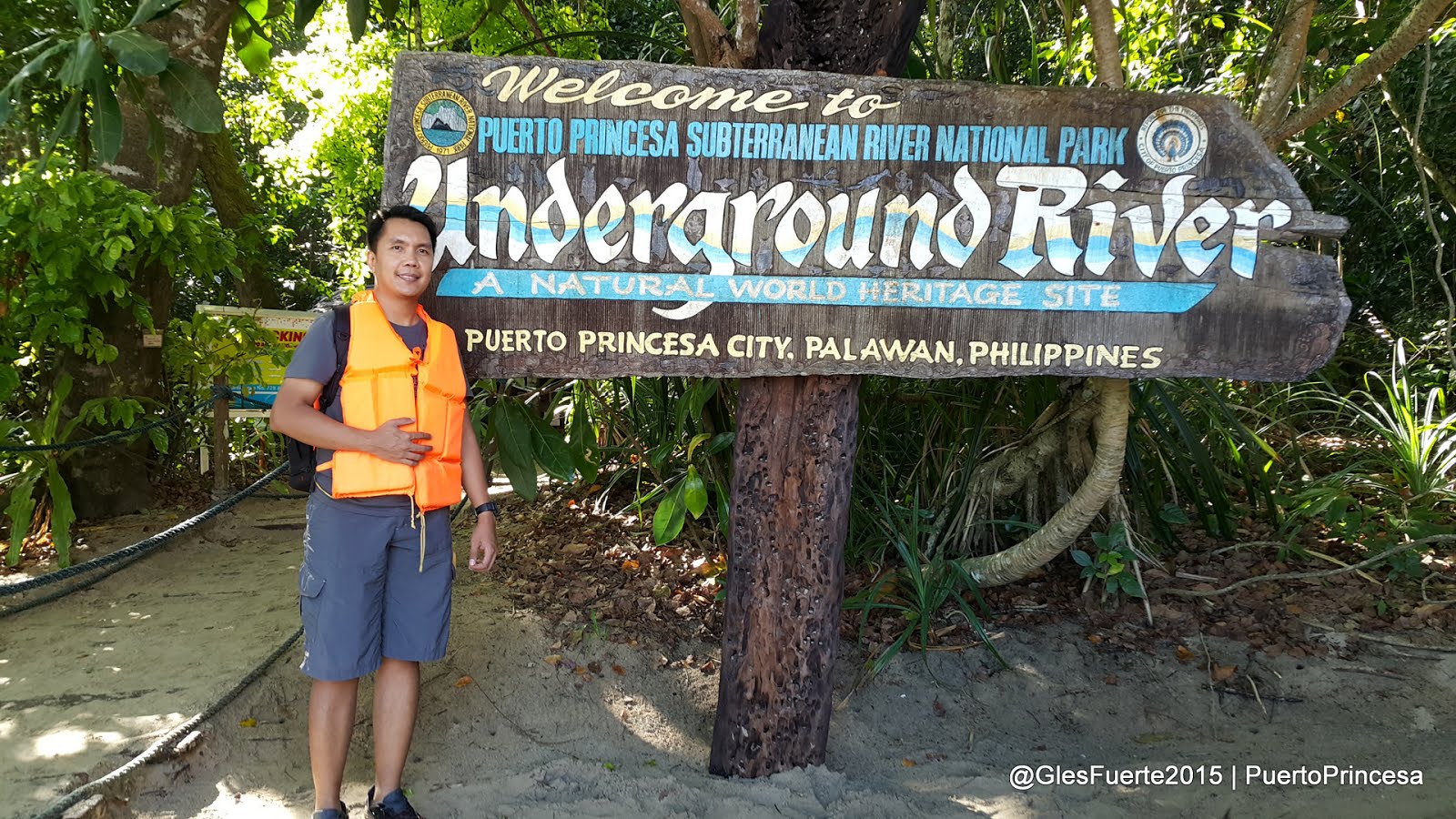
We reached the Puerto Princesa Subterranean River National Park at 0920H. At the entrance of the National Park, there was a short briefing for all tourists emphasizing the rules and regulations that must be strictly observed within the protected area.


We were also informed that the tour is a voice-record guided tour played on an electronic voice recorder. The purpose of this is to minimize noise inside the cave.


There was another queue for the boat that will bring us inside the Underground River. Each boat can carry max of eleven passengers including the guide. We were required to wear life-jacket and protective helmet. I was so excited.

THE UNDERGROUND RIVER

According to Wikipedia, The park has a limestone karst mountain landscape. St. Pauls Underground River Cave is more than 24 km (15 mi) long and contains an 8.2 km (5.1 mi) long underground section of the Cabayugan River.

The river winds through the cave before flowing directly into the West Philippine Sea and is navigable by boat up to 4.3 km (2.7 mi) in from the sea.
Puerto Princesa Subterranean River
The cave includes major formations of stalactites and stalagmites, and several large chambers, including the 360-meter-long Italian's Chamber with approximate 2.5 million square meters volume.

It is one of the largest cave rooms in the world. The lower portion of the river up to 6 km from the sea, is subject to tidal influences. Until the 2007 discovery of an underground river in Mexico's Yucatán Peninsula, the Puerto Princesa Subterranean River was reputed to be the world's longest underground river.

The area also represents a habitat for biodiversity conservation. The site contains a full mountain-to-the-sea ecosystem and has some of the most important forests in Asia. It was inscribed by UNESCO as a World Heritage Site on December 4, 1999.

We started the Underground River tour at 0940H. I took the front row together with a Vietnamese friend.

Upon entering the mouth of the Underground River, I realized that I was inside a very dark realm. It's a pitch-black abyss. The only thing I can see was the light coming from the flashlight of our guide.

As we moved deeper into the dark abyss, there I realized its immense beauty and magnificence - the unparalleled hidden grandeur of the underworld!
 

As the light moved from one section of the cave to another, I saw nothing but massive stone formations that are immensely beautiful. I told myself, this is mother nature's work-of-art for millions of years.
 

I was completely amazed and humbled as I marveled at the grandeur of the major stalactites and stalagmites of varying formations. It is a priceless gift of nature.
 

We had the tour inside the cave for forty five minutes and we reached as far as two kilometers inside. According to our guide, there is also a special tour inside the cave that goes inside as far as 8 kilometers.
 

It was extremely challenging to take photos inside the cave because of the darkness. I was so lucky though to be able to take few shots - just a glimpse, showing a portion of the beauty of the Underground River.
 

The beauty and grandeur of the Puerto Princesa Subterranean River is beyond compare and truly, it deserves being listed as one of the 7 New Wonders of Nature and a UNESCO World Heritage Site.
 

We completed the Underground River tour at 1026H.
 

We left Sabang back to the city with a happy and contended hearts at 1230H. I was back at my accommodation at 1435H.

At 1915H I went out for dinner. This time, I tried Kalui Restaurant. This is a cozy restaurant and very famous to foreign tourists.

In fact, I had to make an early reservation for the 2000H dinner just to make sure that I can be accommodated.

For dinner, I ordered "Kalui Special of the day set" and it was good. I loved the dessert. After dinner, I had the chance the move around the restaurant to explore.


I met a pencil artist Mr. Jerry. I was impressed looking at his works and so I requested him to do a sketch of me.

He delivered the sketch at my accommodation the following day. His works are indeed very nice.

I left Kalui at 2108H and concluded my first day in Puerto Princesa.