Showing posts with label #Basilica. Show all posts

Monday, May 11, 2015

Explore and Discover Vatican - Day 03

City of Vatican
11 May 2015

Explore and Discover BASILICA DI SAN PIETRO | VATICAN MUSEUM | SISTINE CHAPEL.

Mondo Cattolico (Catholic World)
I considered my last day in Rome as the climax of my travel. I dedicated this day to explore and discover the gems of the Vatican City - the most notable is the magnificent Basilica di San Pietro, world's largest Basilica.

ST. PETER'S BASILICA
Entrance to Vatican City
I spent my last day in Rome exploring Basilica di San Pietro, the Vatican Museum and the Sistine Chapel.
Swiss Guards
I started exploring the Basilica at 0812H. I had fun taking shots at the main altar, the ceiling and the paintings inside the church. It was nice to see beams of light from the Basilica windows lighting up th interior of the church.
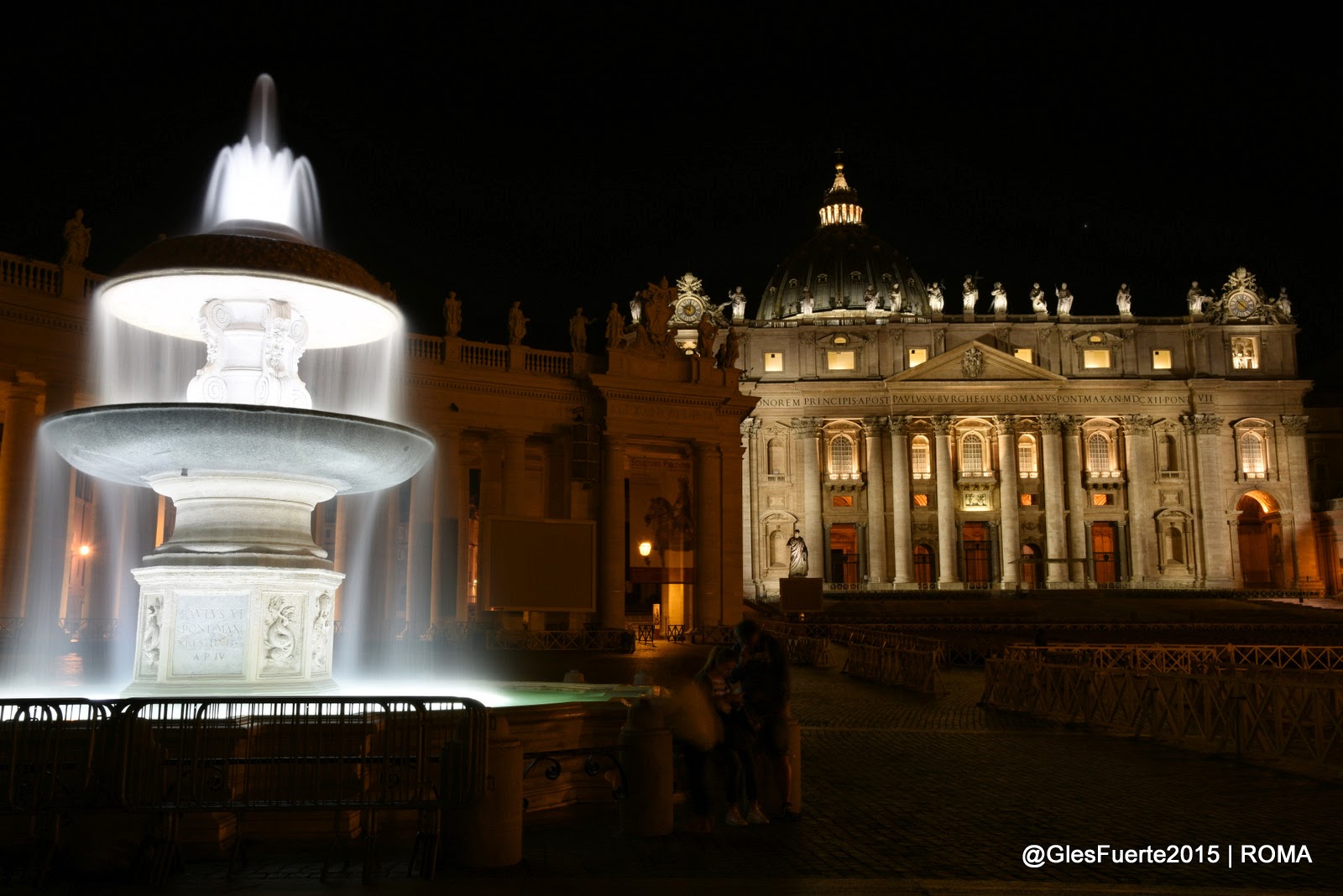
Facade
According to Wikipedia, The Papal Basilica of St. Peter in the Vatican, or simply St. Peter's Basilica (Latin: Basilica Sancti Petri; Italian: Basilica Papale di San Pietro in Vaticano), is a late Renaissance church located within Vatican City.
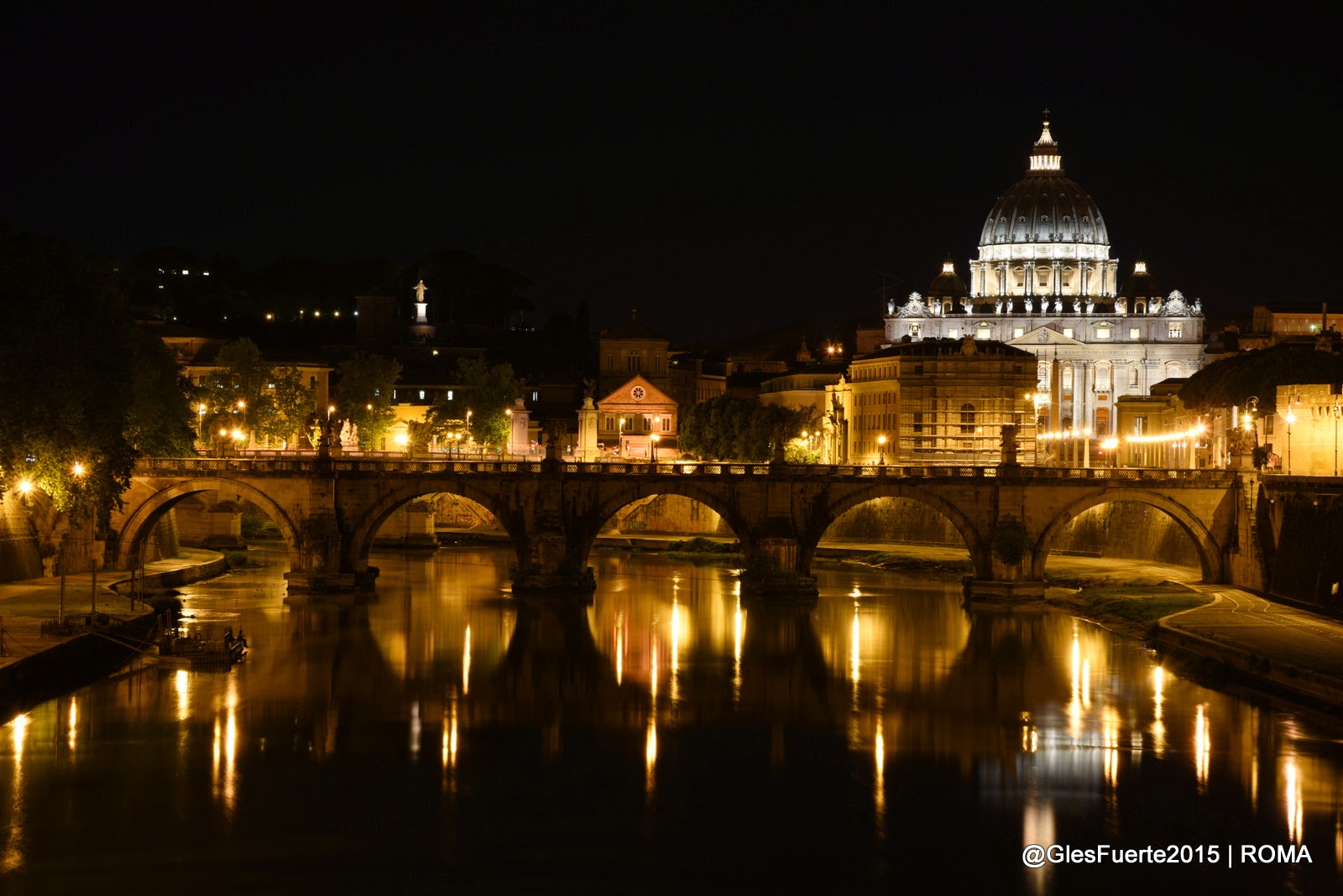
Vatican City at Night
Classical Fountain
Designed principally by Donato Bramante, Michelangelo, Carlo Maderno and Gian Lorenzo Bernini, St. Peter's is the most renowned work of Renaissance architecture and remains one of the two largest churches in the world. 
Roman Clock
While it is neither the mother church of the Catholic Church nor the Catholic Roman Rite cathedral of the Diocese of Rome, St. Peter's is regarded as one of the holiest Catholic shrines. 
Basilica di San Pietro Interior
It has been described as "holding a unique position in the Christian world" and as "the greatest of all churches of Christendom".
By Catholic Tradition, the Basilica is the burial site of its namesake St. Peter, one of the Apostles of Jesus Christ and, also according to Tradition, the first Pope and Bishop of Rome. Tradition and strong historical evidence hold that St. Peter's tomb is directly below the high altar of the Basilica. 
For this reason, many Popes have been interred at St. Peter's since the Early Christian period. There has been a church on this site since the time of the Roman Emperor Constantine the Great. 
Light Beams
Construction of the present basilica, replacing the Old St. Peter's Basilica of the 4th century AD, began on 18 April 1506 and was completed on 18 November 1626.
Altar
St. Peter's is famous as a place of pilgrimage, for its liturgical functions. Because of its location in the Vatican, the Pope presides at a number of liturgies throughout the year, drawing audiences of 15,000 to over 80,000 people, either within the Basilica or its adjoining St. Peter's Square. 
St. Peter's has many strong historical associations, with the Early Christian Church, the Papacy, the Protestant Reformation and Catholic Counter-reformation, and with numerous artists, most significantly Michelangelo. 
Main Altar
As a work of architecture, it is regarded as the greatest building of its age. St. Peter's is one of the four churches of Rome that hold the rank of Major Basilica. 
Pieta
Contrary to popular misconception, it is not a cathedral because it is not the seat of a bishop; the Cathedra of the Pope as Bishop of Rome is located in the Archbasilica of St. John Lateran.


VATICAN MUSEUM and GARDEN
At 1004H, I bought a ticket for 21Eur from the ticket booth at the entrance of the Basilica. This ticket was for the Vatican Museum and the Sistine Chapel.
The entrance to the Vatican Museum and Sistine Chapel is at the rear of the Vatican City. There was a long queue of tourist at that time.
Before getting inside the building for the museum and the Sistine Chapel, I explored the Vatican gardens. I was amazed at the rotating globe at the middle of the square.
According to Wikipedia, The Vatican Museums (Italian: Musei Vaticani) are the museums of the Vatican City and are located within the city's boundaries. They display works from the immense collection built up by the Popes throughout the centuries including some of the most renowned classical sculptures and most important masterpieces of Renaissance art in the world.

Pope Julius II founded the museums in the early 16th century. The Sistine Chapel with its ceiling decorated by Michelangelo and the Stanze della Segnatura decorated by Raphael are on the visitor route through the Vatican Museums. In 2013, they were visited by 5.5 million people, which combined makes it the 5th most visited art museum in the world.

There are 54 galleries, or salas, in total, with the Sistine Chapel, notably, being the very last sala within the Museum.


SISTINE CHAPEL

The passage to the Sistine Chapel is a long narrow corridor. 
Vatican Museum/Passage to Sistine Chapel
The ceiling is painted with biblical figures. I walked through corridors passing through several doors and then finally reaching the Sistine Chapel.
Fresco at the Ceiling
I was completely blown-out looking at the paintings on the ceiling and walls of the Sistine Chapel. The works of Michael Angelo.
Winding Stairway
According to Wikipedia, The Sistine Chapel (Latin: Sacellum Sixtinum; Italian: Cappella Sistina) is a chapel in the Apostolic Palace, the official residence of the Pope, in Vatican City. Originally known as the Cappella Magna, the chapel takes its name from Pope Sixtus IV, who restored it between 1477 and 1480. Since that time, the chapel has served as a place of both religious and functionary papal activity. Today it is the site of the Papal conclave, the process by which a new pope is selected. The fame of the Sistine Chapel lies mainly in the frescos that decorate the interior, and most particularly the Sistine Chapel ceiling and The Last Judgment by Michelangelo.
Sistine Chapel
Image source: http://shotbyanangel.com/wp-content/uploads/2012/08/WebSisteenChapOn.jpg
During the reign of Sixtus IV, a team of Renaissance painters that included Sandro Botticelli, Pietro Perugino, Pinturicchio, Domenico Ghirlandaio and Cosimo Roselli, created a series of frescos depicting the Life of Moses and the Life of Christ, offset by papal portraits above and trompe l’oeil drapery below. These paintings were completed in 1482, and on 15 August 1483 Sixtus IV celebrated the first mass in the Sistine Chapel for the Feast of the Assumption, at which ceremony the chapel was consecrated and dedicated to the Virgin Mary.

Between 1508 and 1512, under the patronage of Pope Julius II, Michelangelo painted the Sistine Chapel ceiling, a masterpiece without precedent, that was to change the course of Western art. In a different climate after the Sack of Rome, he returned and between 1535 and 1541, painted The Last Judgement for Popes Clement VII and Paul III. The fame of Michelangelo's paintings has drawn multitudes of visitors to the chapel, ever since they were revealed five hundred years ago.


I ended my tour in Rome at the Sistine Chapel.
I was completely amazed at Rome. The experience that I had was beyond my expectation. Rome indeed is a romantic, majestic and an amazing city!


Grazie mille , Roma. Ci vediamo!

--o0o--

Majestic Rome
Explore and Discover Rome - Day 01
Explore and Discover Rome - Day 02

Sunday, February 16, 2014

Explore Basilica Minore de San Sebastian in Quiapo

Quiapo, City of Manila

It was a Saturday, my favorite day, my free day. After exploring San Bartolome church in Malabon a few weeks ago, I decided to visit another old church located just almost at my doorstep and explore it.
San Sebastian Church Old Photograph
Photo Source: https://blogger.googleusercontent.com/img/b/R29vZ2xl/AVvXsEhgqAh_k5M5jmxwcipCEN_e04lw5lhLxREyaTK_ELHLqhrMWI8MBQkwzbDS7g6md-1qlEOdkeSqT4A7kzzacnoe3XyBfuwLYMHv7I0Z-GIUTEoEePPmMGEtNls0pDpWiGyrUalHzohdvpR-/s1600/debra.jpg
For many times, I had been passing by Plaza Del Carmen in Quiapo on my route to Intramuros every Sunday for my Sunday obligation at San Agustin church and had been gazing at the light-green facade and pointed bell towers of San Sebastian church but never had the chance to explore it and make some photographs.
San Sebastian Church at Plaza Del Carmen
From my residence at Nagtahan, I took a jeep bound for Divisoria and alighted at Recto. A few steps away is the San Sebastian Church.

San Sebastian church is known for being the only all-steel church in Asia. This is in response to the numerous earthquakes that hit Manila in the last 300 years that destroyed many of the ancestors of the present San Sebastian church.
Construction of San Sebastian Church Old Photograph (Right)
Photo Source: https://blogger.googleusercontent.com/img/b/R29vZ2xl/AVvXsEjQebLsrQ0xX3DF51DrFLl_XMVgqIxATEUhzGuJD3TebwjPn5NdIdxZFIVzt0fjqWREJxXwVdl1lQrPN6TnTQkhBWVD2nqlBPP8WL4crLBP47F4ELw4nPc2bebm3Ss929etzlQYd5Mrq_o/s1600-h/ss1fb.jpg

Background: The Basilica Minore de San Sebastian, better known as San Sebastian Church, is a Roman Catholic minor basilica in Manila, Philippines. It is the seat of the Parish of San Sebastian and the National Shrine of Our Lady of Mt. Carmel.

Completed in 1891, San Sebastian Church is noted for its architectural features. an example of the revival of Gothic architecture in the Philippines, it is the only all-steel church or basilica in asia, and claimed as the only prefabricated steel church in the world. In 2006, San Sebastian Church was included in the Tentative List for possible designation as a World Heritage Site. It was designated as a National Historical Landmark by the Philippine government in 1973.

San Sebastian Church is under the care of The Order of the augustinian Recollects, who also operate a college adjacent to the basilica. It is located at Plaza del Carmen, at the eastern end of Claro M. Recto Street, in Quiapo, Manila.

In 1621, Don Bernardino Castillo, a generous patron and a devotee of the Christian martyr Saint Sebastian, donated the land upon which the church stands now. The original church, made of wood, burned in 1651 during a Chinese uprising. The succeeding structures, which were built of brick, were destroyed by fire and earthquakes in 1859, 1863, and 1880.

In the 1880s, Esteban Martinez, the parish priest of the ruined church, approached the Spanish architect, Genaro Palacios, with a plan to build a fire and earthquake-resistant structure made entirely of steel. Palacios completed a design that fused Earthquake Baroque with the Neo-Gothic style. His final design was said to have been inspired by the famed Gothic Burgos Cathedral in Burgos, Spain.

The prefabricated steel sections that would compose the church were manufactured in Binche, Belgium.

According to the historian Ambeth Ocampo, the knockdown steel parts were ordered from the Societe anonyme des Enterprises de Travaux Publiques in Brussels. In all, 52 tonnes (51 long tons; 57 short tons) of prefabricated steel sections were transported in eight separate shipments from Belgium to the Philippines, the first shipment arriving in 1888.

Belgian engineers supervised the assembly of the church, the first column of which was erected on September 11, 1890. The walls were filled with mixed sand, gravel and cement. The stained glass windows were imported from the Henri Oidtmann Company, a German stained glass firm, while local artisans assisted in applying the finishing touches of the steel church.

The church was raised to the status of a minor basilica by Pope Leo XIII on June 24, 1890. Upon its completion the following year, on August 16, 1891, Basilica Minore de San Sebastian was consecrated by the archbishop of Manila, Bernardo Nozaleda
(Wikipedia).

I was at Sebastian church an hour before 12 noon and I was so lucky to see that the church was open. I learned that a baptismal ceremony was just completed and I was the only person inside the church.
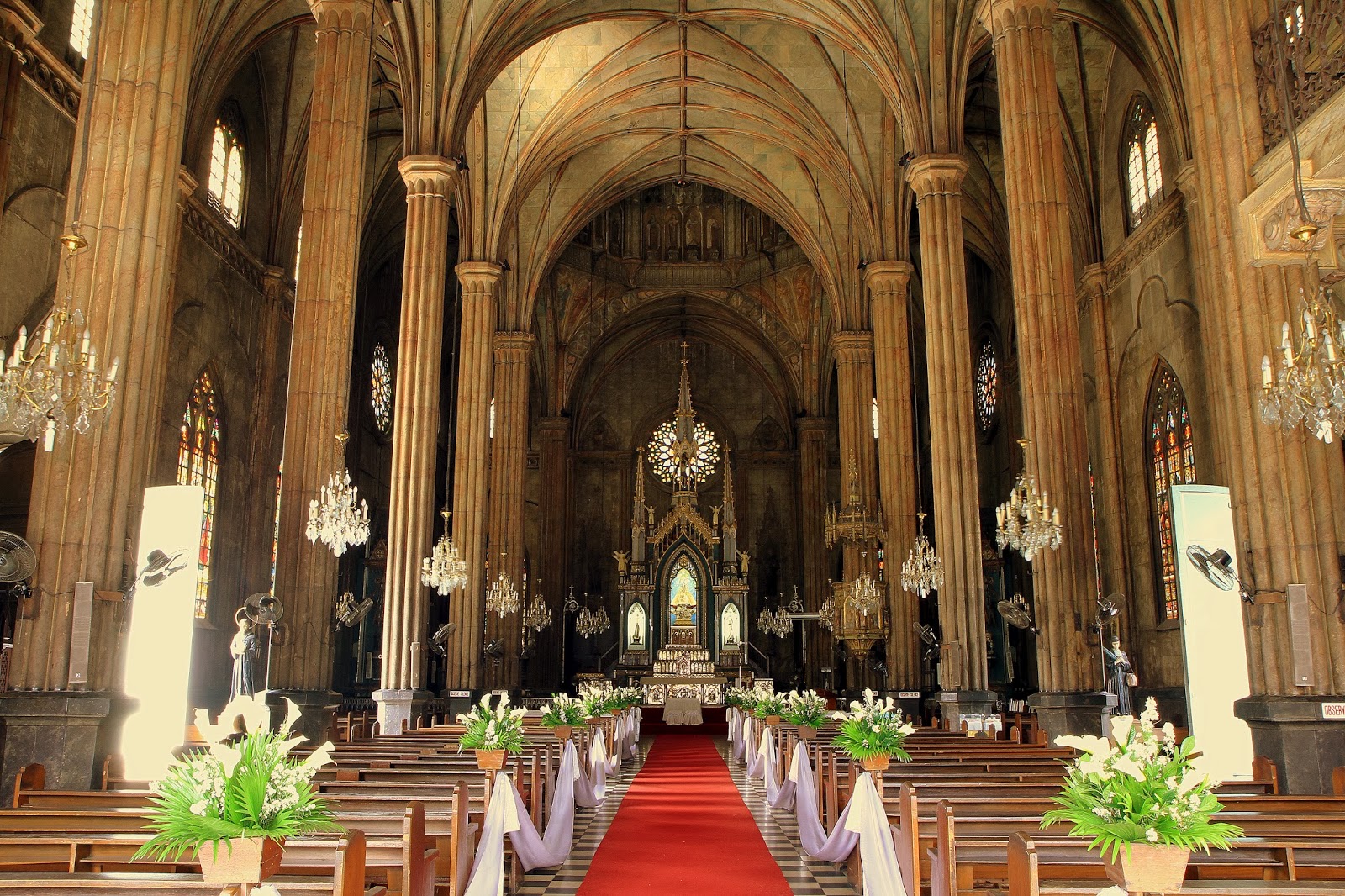
Church Interior of Gothic Architecture
It was quite dark inside the church and all the stained glass windows were casting a beautiful reflection inside the church from the sun.

The center isle was covered with the red carpet.
Main Altar and Steel Pulpit
San Sebastian church architecture features a Gothic architecture. The old Trompe l'oeil paintings on the wall still exist and of course the old pulpit still hangs on the steel column near the altar.
The biggest challenge for San Sebastian church is rust. The exterior needs to be repainted with several layers to keep it safe from rust. There are evidences of rust on the columns and walls of the church from inside.

I learned that the steel were fabricated in Belgium and then transported to Manila on board 6 ships and then assembled in Manila at the church present location by Belgian engineers like a Lego.
Church Main Entrance
There were also claims that Gustave Eiffel may have been involved in the design of San Sebastian Church.

No matter who designed San Sebastian, undoubtedly, it is a great achievement, a heritage and an important monument that must be protected.
Main Altar and Stained Glass
This church is one of the few structures that survived the bombings of World War II.

Having the chance to explore San Sebastian church was an accomplishment for me.

I am impressed by the Gothic architecture of this marvelous steel structure.


See more photos.

-o0o-

Saturday, February 11, 2012

Exploring Taal Basilica

Town of Taal, Province of Batangas
11 February 2012

Onboard JAM liner bound for Lemery Batangas, I traveled down south of Manila for another fun road trip, photo ops and to explore a town called Taal in Batangas. 
According to Philippine history, Taal was first founded in present day San Nicolas in 1572 by the Augustinian Friars but due to the eruption of Taal Volcano in 1754, the town was moved to its present site for protection. The town became the capital of Batangas until it was moved to Batangas City.
Church Facde
After 3 hours of bus travel, I finally reached the sleepy town of Taal. The first view that captured my interest was the gigantic fascade of the Basilica de San Martin de Tours (also known as Taal Church). 
Church Interior
Philippine history says, Taal church is the biggest church in the Philippines, was first built in 1575 in present day San Nicolas but abandoned in 1754 due the eruption of Taal and rebuilt in 1755. Then an earthquake shook it down in 1849 and once again rebuilt in 1856 by Architect Luciano Olivero. 
Dome
The Taal church is an amazing architectural structure. Its massive stone columns is a very nice subject for photography. The large original bell is displayed at the plaza. 
Caysasay Church
After spending an hour taking shots at the plaza and enjoying the view of the fascade, I went inside to see its interior. The interior is superb. The dome and the ceiling are painted. There are portions though that are under construction. The pulpit is still intact and the altar is magnificent. 
Caysasay Interior
After exploring the interior of the church, I decided to climb up the bellfry. After getting approval from the church admin office, I climbed more than 50 steps on a very narrow stairway going up the bellfry. At the top, the view of the town of Taal immerged just like a painting canvass. The bellfry though is under construction. The original bells were replaced with new ones operated by an electric motor.
Ancestral Houses
After exploring the Taal church, I decided to see one more church nearby. The Caysasay church I believe, just like Taal, is also ancient. The exterior though is quite plain. The interior is still intact. The paintings on the ceiling, the pulpit and the dome are still in good condition. 

Several Heritage houses can be found along "Calle Agoncillo". Taal s now a Heritage town and is known as the Barong Tagalog and Balisong capital of the Philippines.

====================
====================

-----o0o-----